
Ford Escape Tire Pressure Sensor Fault: Causes and Fixes
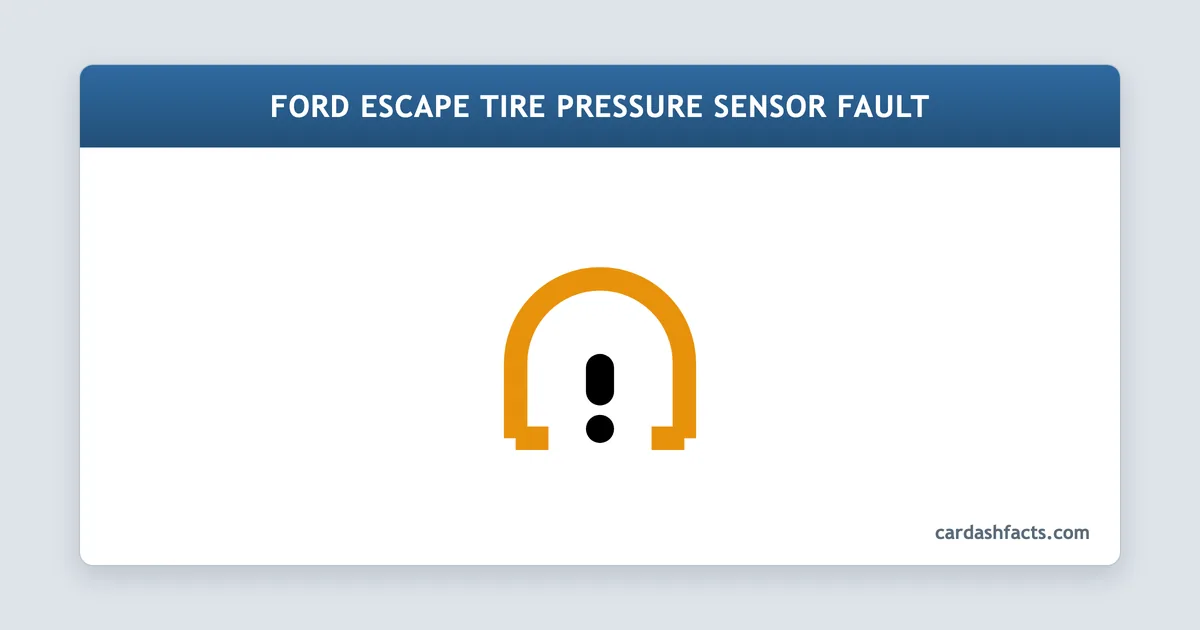
| Light color | Amber |
|---|---|
| Urgency | Service soon (amber) |
| Safe to drive | Yes, but TPMS monitoring is inactive until resolved |
| Common cause | Dead sensor battery (sensors last 7-10 years) |
| DIY or shop | Either |
When your Ford Escape shows Tire Pressure Sensor Fault (or the TPMS warning light flashes for 60-90 seconds before staying on), the system cannot communicate with one or more wheel sensors. The tires may be at the correct pressure - the problem is with the sensor itself, its battery, or the system's stored ID data.
The distinction matters because adding air will not clear this message. You need to address the sensor, the relearn procedure, or both.
Sensor Fault vs. Low Pressure: Know the Difference
Ford Escape TPMS alerts come in two forms. A solid TPMS light means one or more tires are 25% or more below the recommended pressure - simply inflate them and the light clears within a few miles. A flashing light (60-90 seconds at startup, then solid) is the system telling you it cannot receive a valid signal from a sensor. That is the fault condition this article covers.
The dash message itself may read Tire Pressure Sensor Fault or Tire Pressure Monitor Fault depending on the model year. Both mean the same thing: the receiver inside the car lost contact with at least one wheel-mounted transmitter.
- Tire Pressure Sensor FaultAmber
- Meaning: System cannot communicate with one or more TPMS sensors; monitoring is inactive.Recommended action: Check sensor age, inspect for damage after tire work, perform relearn procedure.
Common Causes
Dead sensor battery. Every Ford Escape TPMS sensor contains a sealed lithium battery. On 2006-2020 models the expected service life is 7-10 years. When that battery dies the sensor stops transmitting and the receiver logs a fault. There is no way to replace the battery alone - the entire sensor (roughly $25-60 per corner for aftermarket, more for OEM) must be swapped.
Tire rotation or new tires without relearn. The Escape's TPMS module stores the unique ID of each sensor matched to a wheel position. Rotating tires or fitting new sensors puts different IDs in positions the module no longer recognizes, producing a fault. A proper relearn after any tire service writes the new IDs to the module.
Physical sensor damage. A sensor valve stem can be bent or snapped during a tire change if the technician is not careful, or cracked by a pothole impact. Inspect the valve stems visually if the fault appeared right after tire work.
Interference or module issues. Aftermarket accessories transmitting on 315 MHz or 433 MHz (the frequencies Ford sensors use, depending on year) can occasionally interfere. A faulty TPMS receiver module is rare but does occur on older high-mileage Escapes. Battery current sensor faults can also cause scattered electrical complaints that look like sensor faults.
How to Reset the TPMS
Before trying any reset, inflate all four tires (and the spare if it has a sensor) to the pressure listed on the door-jamb sticker. A sensor still in spec needs correct pressure before the relearn will stick.
Static relearn (no tool, most 2007-2014 Escapes):
- Turn the ignition to OFF with all doors closed.
- Press and release the brake pedal.
- Turn the key from OFF to RUN (engine off) three times within 10 seconds, ending in RUN.
- Press and release the brake pedal. A horn chirp or message confirms training mode is active.
- Starting at the left front, hold a TPMS activator tool (or the rim of a properly inflated spare) near the valve stem until the horn chirps, then move clockwise to right front, right rear, left rear.
- Turn the ignition off. The system has stored the IDs.
OBD relearn (2015 and newer, or when the static method fails): A TPMS scan tool connects to the OBD-II port and writes sensor IDs directly to the module. Most tire shops and dealerships have this tool. The procedure takes about five minutes.
Auto-relearn (some 2011+ models): Drive above 15 mph for up to 20 minutes. The module may self-learn sensor positions without additional steps. Check your owner's manual for the specific procedure for your model year.
Replacing a Dead Sensor
If a sensor battery is confirmed dead by a TPMS scan tool (the tool will show 'sensor not found' or 'no response' for that wheel), replacement is straightforward but requires a tire dismount. A shop will demount the tire, swap the sensor, torque the new valve stem nut to spec (typically 106 in-lb for most Ford applications), remount and balance the tire, then perform the OBD relearn.
Aftermarket sensors from brands like Schrader, Dorman, or VDO that are pre-programmed to Ford frequency work reliably and cost significantly less than Ford OEM parts. Confirm the frequency (315 MHz for most pre-2012 Escapes, 433 MHz for 2012 and newer) before ordering. If replacing one sensor due to age, replacing all four at once avoids revisiting the same job within a year or two as the others fail.
For related electrical diagnosis work, brake pedal position sensor problems follow a similar diagnostic process if you are chasing intermittent no-start or safety-circuit faults on the same vehicle.
When the Light Comes Back After Reset
If the fault message returns within a few drive cycles, the most likely causes are a sensor that has completely failed (dead battery confirmed), a second sensor also nearing end of life, or an incorrect relearn sequence that did not actually write the IDs. Run a dedicated TPMS scan to read each sensor's signal strength, battery voltage, and ID. A scanner that reads live TPMS data removes the guesswork entirely.
A TPMS receiver module fault is rare but does happen on Escapes with over 150,000 miles. If the scanner shows all sensors transmitting valid IDs but the module still logs a fault, the module itself may need replacement or reprogramming.
Frequently Asked Questions
Q: Can I drive with the Tire Pressure Sensor Fault light on?
A: Yes, the vehicle is drivable. The fault means the monitoring system is not reporting accurate data, not that the tires are unsafe to drive on. Check tire pressure manually with a gauge and correct any underinflation, then schedule sensor service.
Q: Will adding air to my tires fix the sensor fault message?
A: No. If the message says 'Sensor Fault' or the TPMS light is flashing at startup, adding air will not clear it. The problem is communication with the sensor, not tire pressure. You need a relearn procedure or sensor replacement.
Q: How much does it cost to replace a TPMS sensor on a Ford Escape?
A: Aftermarket sensors typically run $25-60 each. OEM Ford sensors are higher. Add one hour of shop labor for tire dismount, sensor swap, remount, balance, and relearn. Total cost per corner at a tire shop is usually $80-150.
Q: My Escape just had new tires installed. Why does the sensor fault light appear now?
A: The shop likely did not perform a TPMS relearn after mounting the tires. The module lost track of sensor positions during the service. Return to the shop and ask them to complete a TPMS relearn - it takes only a few minutes and should be included at no charge.