
How to Fix the EPC Light on an Audi Q5
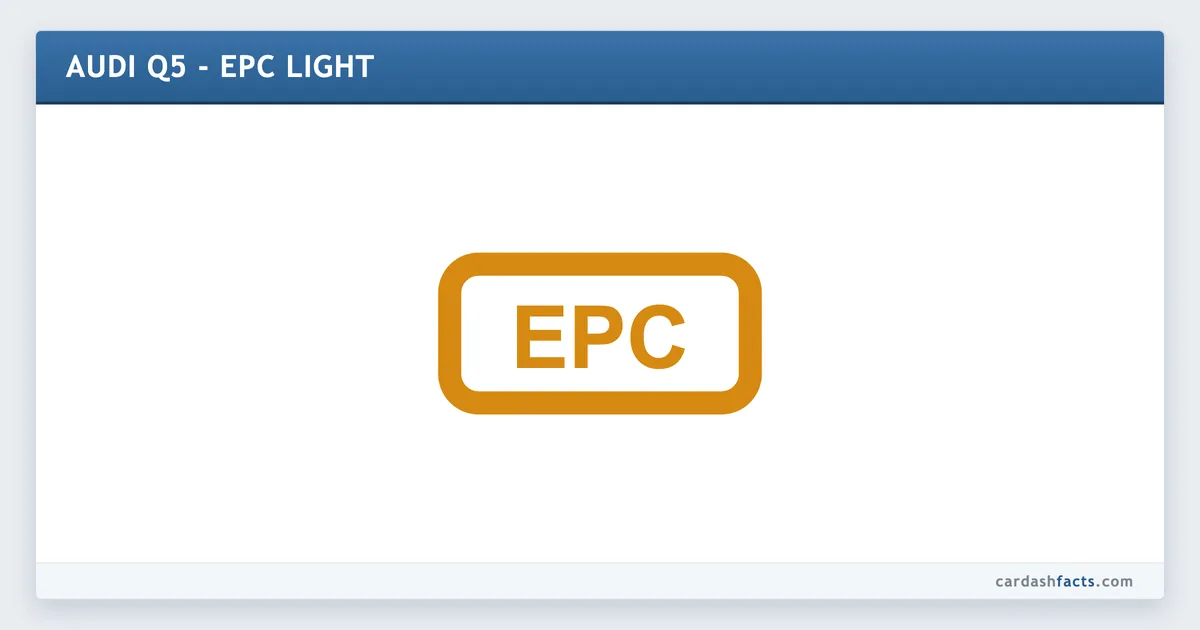
| Light color | Amber |
|---|---|
| Urgency | Medium to high - drive gently, diagnose soon |
| Common causes | Throttle body, brake light switch, accelerator pedal sensor, ABS sensor, MAF, ignition coils |
| Can you drive | Short distance gently; avoid highway driving; stop if handling feels unsafe |
| Typical fix | Scan fault codes first, then clean or replace the faulty component |
The EPC light on an Audi Q5 stands for Electronic Power Control. It is an amber warning that signals a fault in the electronic throttle or engine management system. It often appears alongside the check engine light, and sometimes the traction control light too. In some cases the car drops into limp mode, limiting you to around 2,500-3,000 RPM. The causes range from a $15 brake light switch to a $400+ throttle body - reading the fault codes first tells you exactly where to look.
What the EPC light means on an Audi Q5
EPC stands for Electronic Power Control. On the Q5, this system manages the drive-by-wire throttle - there is no mechanical cable between the accelerator pedal and the throttle plate. Instead, a sensor on the pedal sends a signal to the ECU, which then tells the throttle body how far to open.
When something disrupts that chain - a failing sensor, a dirty throttle body, a wiring fault - the ECU detects the mismatch and triggers the EPC light. To protect the engine from uncontrolled acceleration or damage, it may also activate limp mode, cutting power sharply until the fault is cleared.
The EPC light is Audi and VW Group specific. You will not see it on most other brands. On its own, a short orange glow that clears after restart is sometimes a one-off glitch. If it stays on, comes back repeatedly, or the car feels sluggish or jerky, that needs attention soon.
Common causes of the EPC light on an Audi Q5
Brake light switch - This is the single most common and cheapest cause. The switch sits behind the brake pedal and tells the ECU when you are braking. A failed switch confuses the throttle control logic and triggers EPC immediately. The part typically costs $10-$25 and clips in place in minutes. Always check this first.
Throttle body - Carbon buildup on the throttle plate or a failing throttle position sensor inside the body is the second most frequent cause. The Q5 2.0T throttle body is a known weak point. You can sometimes clean it with throttle body cleaner and a soft cloth (do not spray cleaner directly into the housing with the car running). Replacement runs roughly $200-$500 for the part, plus labor.
Accelerator pedal position sensor - The pedal assembly contains two redundant sensors. If either sends an out-of-range reading, the ECU disables power and lights the EPC. The pedal assembly on 2009-2018 Q5 models is a common failure item. It usually stores a specific fault code like P2138 (throttle/pedal position sensor correlation).
ABS or steering angle sensor - The stability and traction control systems share data with the throttle control module. A faulty ABS wheel speed sensor or a steering angle sensor that loses calibration can cascade into an EPC warning. This often comes with the ESC light as well.
MAF sensor - A dirty or failing mass airflow sensor sends incorrect air volume data to the ECU. The ECU cannot calculate the right throttle response and may set EPC alongside a P0101 or P0102 code. Cleaning the MAF with dedicated MAF cleaner solves it in some cases.
Ignition coils or spark plugs - A misfiring cylinder creates erratic engine behavior that the ECU interprets as a throttle system anomaly. EPC can appear together with P030X misfire codes. Worn plugs or a cracked coil pack are the typical culprits on higher-mileage Q5s.
Battery or wiring - A weak battery causes voltage drops that confuse control modules and produce ghost faults including EPC. A corroded ground strap or a chafed wire to the throttle body can have the same effect. Check battery voltage (should be 12.4-12.7V at rest) and inspect ground connections on the engine block.
How to fix the EPC light on an Audi Q5 (step by step)
Step 1 - Read the fault codes. A generic OBD2 reader will often show nothing because EPC faults live in the throttle or ABS control module, not just the engine ECU. Use an Audi-capable scanner (VCDS/VAG-COM is the gold standard; OBDEleven and some Autel models also access these modules). Note every stored and pending code before clearing anything.
Step 2 - Check the brake light switch. Get out and ask someone to press the brake pedal while you look at the brake lights. If one or both are out, or the switch feels loose or click-less, replace it. On the Q5 it is a twist-lock on the pedal bracket, accessible from under the dash. Clearing the fault code after replacement usually resolves EPC immediately if this was the cause.
Step 3 - Inspect and clean the throttle body. With the engine off and cold, remove the intake hose at the throttle body. Use a cloth and throttle body cleaner to wipe carbon deposits off the throttle plate and bore walls. Reconnect, start the car, and let the ECU relearn the throttle position (some Q5 models require a basic settings procedure with VCDS). If a fault code specifically calls out the throttle body sensor or actuator, replacement is the more reliable fix.
Step 4 - Check the accelerator pedal sensor. If the code is P2138 or similar, the pedal assembly is the target. This is a straightforward swap - the unit unplugs and is held by two or three bolts. After replacement, clear the codes and perform a throttle basic settings adaptation if prompted by the scanner.
Step 5 - Address ABS or MAF codes. If the fault codes point to a wheel speed sensor, visually inspect the sensor and its wiring harness at each wheel. A cracked reluctor ring on the axle can also cause erratic readings. For MAF codes, try cleaning first with MAF sensor cleaner (not throttle body cleaner); replace if cleaning does not clear the fault after a test drive.
Step 6 - Check battery health. Have the battery load-tested at any auto parts store. A battery reading below 12.4V at rest or dropping sharply under load should be replaced. Also check the main negative ground strap from the battery to the chassis and from the engine block to the body.
Step 7 - Clear the code and test drive. After the repair, clear all fault codes and drive the car through normal conditions including some hard acceleration. If the EPC light does not return, the fix held. If it comes back, re-scan for any new or returning codes.
Can you drive with the EPC light on?
It depends on what the car is doing. If the EPC light came on briefly and the car drives normally, you can usually get to a shop without drama - but do not ignore it. Scan the codes as soon as you can.
If the car is in limp mode - sluggish response, will not rev past 2,500-3,000 RPM, stumbles at speed - keep it off the motorway. Limp mode is a safety default, not a permanent damage situation, but pushing a car hard in limp mode can mask other faults and lead to bigger problems.
Do not drive at all if the steering feels heavy or unpredictable, the brakes behave oddly, or the car shakes badly at idle. Those symptoms suggest the fault is affecting safety-critical systems, not just engine power output.
Switching the car off and restarting sometimes clears a temporary EPC glitch - a brief voltage dip or one-time sensor hiccup. If it stays off after a restart and the car feels normal, still get the codes read within a day or two. Intermittent EPC faults get worse over time.
Frequently Asked Questions
Q: Can I reset the EPC light myself without a scanner?
A: Disconnecting the battery for 10-15 minutes will clear stored fault codes, including EPC. The light will go off - but if the underlying problem is still there, it will come back on within a short drive. Resetting without fixing the cause just delays the diagnosis. A proper scan with an Audi-compatible tool tells you which component actually failed, saving you from guessing.
Q: Is the EPC light expensive to fix on an Audi Q5?
A: It depends entirely on the cause. A brake light switch - one of the most common triggers - costs under $25 and takes 10 minutes to replace. Cleaning a dirty throttle body is a free DIY job. At the expensive end, a replacement throttle body with labor runs $400-$800 at an independent shop, more at a dealership. Getting the fault codes read first is worth the $50-$100 diagnostic fee because it usually points you directly to the faulty part.
Q: Why does the EPC light come on with the check engine light?
A: The EPC and check engine systems share sensor data. A fault in the throttle body, pedal sensor, or MAF often triggers both at once because the engine management ECU and the throttle control system are monitoring the same components. The specific fault codes stored in both modules together usually paint a clear picture of where the failure is.
Q: Does the EPC light mean my Audi Q5 will go into limp mode?
A: Not always, but it can. Limp mode is triggered when the ECU detects a fault serious enough to risk uncontrolled acceleration or engine damage - typically a throttle body or pedal sensor fault. Minor causes like a brake light switch or a marginal MAF reading often set the EPC light without triggering limp mode. If the car feels sluggish and will not rev past about 3,000 RPM, it is in limp mode and you should have it diagnosed before driving it any distance.