
Honda Odyssey Sliding Door Won't Close
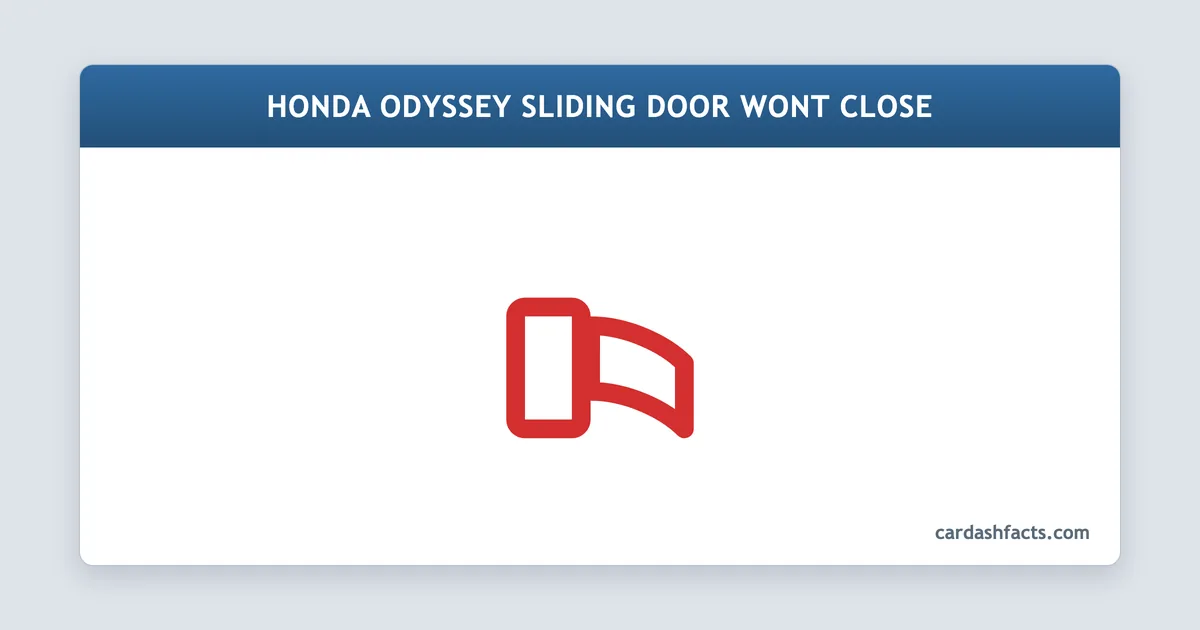
| Light color | Red |
|---|---|
| Urgency | Informational - but fix before driving |
| Safe to drive | Short distance only - door must be secured |
| Common cause | Dry or failed latch microswitch |
| DIY or shop | Either |
On most Honda Odysseys, a sliding door that won't close - or closes but immediately reopens - points to a failed latch microswitch, a dry latch assembly, a damaged anti-pinch sensor strip, or a worn closing motor cable. The power system will refuse to latch if any sensor tells it the door is obstructed or already shut.
Manual closing bypasses the motor but still relies on the mechanical latch. If the door won't stay closed even when pushed hard by hand, the latch itself or the striker alignment is the problem - not the electronics.
How the power sliding door system works
The Odyssey's power sliding door uses a cable-driven motor, a latch assembly with an integrated microswitch, and rubber anti-pinch sensor strips along the leading edge. When you press the button or use the key fob, the control unit checks all sensors before allowing the door to pull closed. If any sensor reports an obstruction or an error, the door reverses or stops mid-travel.
The latch assembly contains two parts that work together: the main U-hook (which rotates to capture the striker on the B-pillar) and a small microswitch that tells the BCM the door is fully latched. When either part fails or dries out, the system gets conflicting signals and the door refuses to stay closed.
- Door Ajar WarningAmber
- Meaning: One or more doors are not fully latched - the BCM is not receiving a 'closed' signal from the latch microswitchRecommended action: Check that the door is fully pushed shut; if the light stays on with the door closed, the latch microswitch or sensor wiring needs attention
Most common causes and how to diagnose each
Dry or failed latch microswitch. This is the leading cause on 2005-2017 Odysseys. The latch assembly contains small gears and a microswitch that wear and dry out around the 8-12 year mark. Symptoms: the door closes manually but the dash shows a door-ajar warning, or the power door reverses just before full closure. Fix: clean the latch area with rubbing alcohol, then apply white lithium grease to the gear teeth and the rotating U-hook. If the switch itself is broken, the entire latch actuator assembly needs replacement (typically $80-150 in parts).
Anti-pinch sensor strip damage. The rubber strips along the door's leading edge contain pressure-sensitive conductors. A crack, tear, or heavy dirt buildup sends a false obstruction signal. Run your fingers along both strips and look for cracks or flat spots. Clean with a damp cloth and inspect carefully - a pinched or kinked strip at the bottom corner is a frequent miss.
Cable or motor failure. If the door moves partway and then stops with a grinding sound, the cable drum inside the motor has slipped or broken. The door will often close manually in this case but won't power-close. A replacement motor/cable assembly for a 2005-2010 Odyssey runs $150-250 in parts.
Striker misalignment. After a minor collision or if a hinge roller is worn, the door can drift out of alignment so the U-hook doesn't engage the striker cleanly. Look at the striker plate on the B-pillar - fresh scrape marks or a worn groove indicate the latch is just catching the edge. Small striker adjustments (loosen the two mounting bolts, reposition, re-tighten) can fix this without parts.
Step-by-step reset and basic fix procedure
Try these steps in order before replacing parts:
- Step 1 - Battery reset. Disconnect the negative battery terminal for 10 minutes. This clears the power door control unit's fault memory. Reconnect and test - the door may require a recalibration cycle (open fully, close fully once under power).
- Step 2 - Fuse pull. If the battery reset alone doesn't work, pull fuse #13 from the passenger-side fuse box for 30 seconds with the battery connected, then reinsert. This resets only the sliding door module without losing radio presets.
- Step 3 - Clean and lube the latch. With the door open, locate the latch assembly at the rear edge of the door. Spray the area with brake cleaner to remove old grease and grit. Once dry, apply white lithium or wheel-bearing grease to the gear and U-hook. Manually rotate the U-hook with a screwdriver to work the lube in.
- Step 4 - Check anti-pinch strips. Wipe down the full length of both rubber strips with a damp cloth. Press along the strip to feel for dead spots where the conductor may have separated.
- Step 5 - Test the latch switch. With a multimeter in continuity mode, probe the latch microswitch connector. It should change state when you manually rotate the U-hook. No change means the switch is dead and the assembly needs replacement.
If manual closing works but power closing fails after all of the above, the issue is in the motor, cable, or control unit - at that point a shop with a Honda-compatible scanner can pull specific codes such as B1565 (door ajar circuit) or B1318 (latch motor circuit) to narrow it down. See Honda diagnostic codes for more on how Honda's BCM reports body system faults.
When to use manual mode instead
Every Odyssey has a main power door switch on the dashboard (left of the steering column) that disables power operation. With that switch off, the door becomes fully manual. Use manual mode as a temporary measure while you source parts or schedule service - do not drive with the door held shut by bungee cord or cargo straps.
On older Odysseys (2005-2010), a separate manual release cable inside the door trim allows you to disengage the latch motor entirely if the cable has jammed. Consult the owner's manual for the exact location on your model year. The relationship between body control faults and powertrain is worth understanding - on some Odyssey trims, a persistent door-open signal can prevent the transmission from engaging drive as a safety precaution.
Frequently Asked Questions
Q: Why does the sliding door close but then reopen on its own?
A: The most common reason is a false anti-pinch signal. The door reaches the striker, starts to latch, and then the safety system triggers a reversal because a sensor strip reported pressure. Check the rubber anti-pinch strips along the door's leading edge for cracks or debris. A dry latch microswitch that doesn't confirm full closure can also cause the door to cycle back open.
Q: Can I reset the Honda Odyssey sliding door without disconnecting the battery?
A: Yes. Pull fuse #13 from the passenger-side fuse box for 30 seconds, then reinsert it. This resets the sliding door control module independently. After reinserting the fuse, open the door fully by hand, then let it power-close once to complete the recalibration cycle.
Q: How much does it cost to fix an Odyssey sliding door that won't close?
A: If lubrication solves it, the cost is under $10. A replacement latch actuator assembly runs $80-150 in parts, plus 1-2 hours of labor at a shop. A full cable and motor assembly is $150-250 in parts. Striker adjustment is typically a free 15-minute fix if the alignment is only slightly off.
Q: My Odyssey sliding door beeps while driving but appears closed - what's wrong?
A: The beeping means the BCM is not receiving a confirmed 'latched' signal from the door. The door may be physically shut but the latch microswitch inside the assembly has failed or is intermittent. Clean and lubricate the latch first. If the beeping continues, the microswitch or the full latch actuator needs replacement.