
Case IH Tractor Dashboard Warning Lights and Symbols
| Light color | Red |
|---|---|
| Urgency | Varies - red lights require immediate engine shutdown |
| Safe to drive | Stop for red, service soon for amber, informational for green |
| Common cause | Varies by symbol |
| DIY or shop | Either |
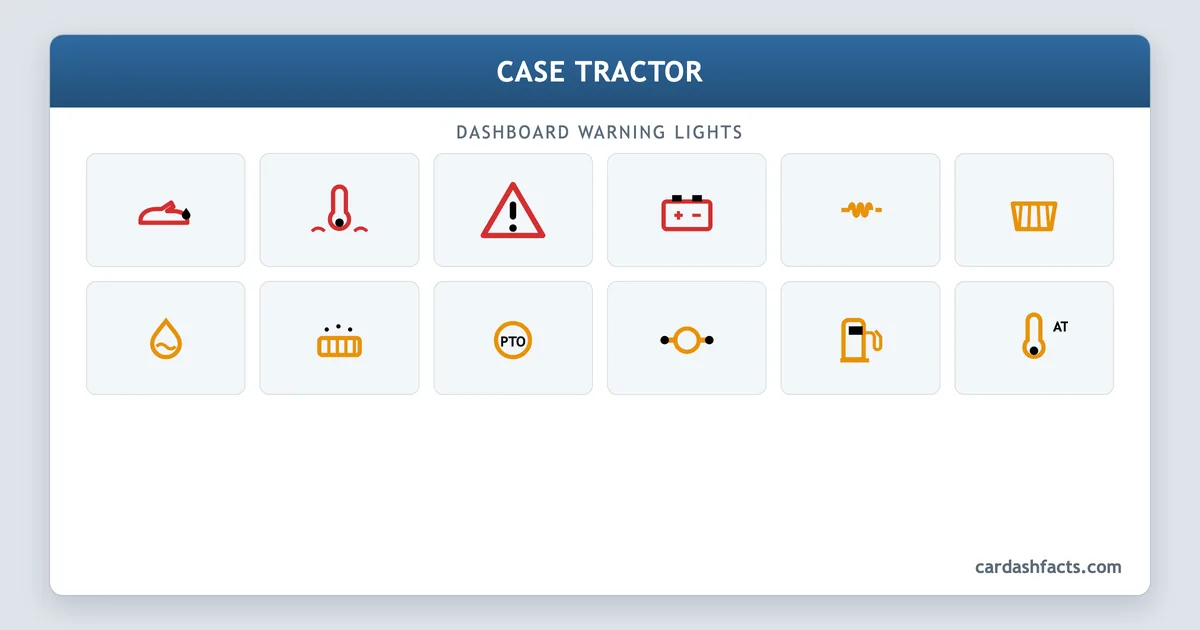
Case IH tractor warning lights follow a three-color logic: red means stop the machine immediately, amber means attend to it before the next work session, and green (or blue) lights are informational status indicators. Understanding which light is which - and what it demands of you - is how you avoid a blown head gasket in the middle of planting.
This guide covers the most common instruments on Case IH Maxxum, Puma, and Farmall models. If a light appears that is not listed here, the cluster will usually show a numeric code alongside it; cross-reference that code in your operator manual for the specific fault.
Red warning lights - stop immediately
Any red light on a Case IH cluster is a demand to stop work and shut down the engine. Continuing to operate risks irreversible damage to the engine, hydraulic system, or transmission. The three most critical red lights are oil pressure, coolant temperature, and the master warning light that aggregates multiple fault sources.
When a red light appears, bring the tractor to a safe stop, disengage the PTO, lower any implements to the ground, and shut off the engine. Do not restart until you have identified the cause. For broader context on how agricultural equipment handles critical system faults, the Case IH warning lights symbol reference covers the full range of instruments across model lines.
- Engine Oil PressureRed
- Meaning: Engine oil pressure has dropped below the safe minimum; the engine is running without adequate lubricationRecommended action: Stop the engine immediately. Check oil level and inspect for leaks before attempting a restart.
- Engine Coolant TemperatureRed
- Meaning: Coolant temperature is above the safe limit; the engine is at risk of overheatingRecommended action: Shut down and let cool. Check coolant level, inspect the radiator screens for debris, and check the fan belt.
- Master Warning / StopRed
- Meaning: A critical fault has been detected; may aggregate multiple systems depending on the model yearRecommended action: Stop immediately, check all other gauges and indicator lights, and record any associated fault code.
- Hydraulic Oil TemperatureRed
- Meaning: Hydraulic fluid temperature has exceeded safe limits, typically during sustained high-load work in hot weatherRecommended action: Stop work, lower implements, and idle the engine to allow the system to cool before resuming.
Amber warning lights - service required
Amber lights allow you to finish the row or bring the machine to a suitable stopping point, but they should not be ignored past that session. Several amber conditions will escalate to red if left unaddressed - a fuel filter restriction, for example, can starve the injectors if the element is not replaced.
Case Farmall and Maxxum models share most of these indicators; Puma models add emissions-related lights (DPF regeneration, DEF level) that are absent from older pre-Tier-4 machines. The Case Farmall warning lights breakdown covers the utility and compact Farmall lines specifically if your machine is a smaller model.
- Battery / Charging SystemAmber
- Meaning: The alternator is not charging the battery adequately; battery voltage is below the charging thresholdRecommended action: Check the alternator belt for wear or slippage, inspect the battery terminals for corrosion, and test the alternator output.
- Glow Plug / PreheatAmber
- Meaning: Intake air preheat is active; the engine is warming the combustion chambers before cranking in cold temperaturesRecommended action: Wait for the light to go out before cranking. Forcing a cold start before preheat finishes increases wear and can cause hard starting.
- Air Filter RestrictionAmber
- Meaning: The primary air filter element is blocked; intake restriction is affecting engine performanceRecommended action: Inspect the air filter and clean or replace the primary element. Check the pre-cleaner bowl and empty it if full.
- Water in FuelAmber
- Meaning: The fuel filter water separator has collected enough water to trigger the sensorRecommended action: Drain the water separator bowl before the next start. Continuing to run with water in the fuel system can damage injectors.
- Fuel Filter RestrictionAmber
- Meaning: The fuel filter element is clogged and flow is restricted; injector fuel delivery may be compromisedRecommended action: Replace the fuel filter element. If the engine is already showing power loss, do not delay.
- DPF / Exhaust Filter RegenerationAmber
- Meaning: The diesel particulate filter has reached the soot load threshold and needs to regenerate (Tier 4 Final models)Recommended action: If the machine is at safe load, a parked or active field regeneration will clear the filter. Consult the operator manual for the correct procedure for your model.
- Transmission TemperatureAmber
- Meaning: Transmission fluid temperature is elevated, typically from sustained high-draft or loader workRecommended action: Reduce the work rate or implement load. If the light does not go out after reducing load, stop and check the transmission fluid level.
- Engine Oil TemperatureAmber
- Meaning: Engine oil is running hotter than the normal operating band; early warning before a red conditionRecommended action: Reduce PTO load and check that the oil cooler passages are not blocked. Low oil level can also cause this light.
- Low FuelAmber
- Meaning: Fuel level is below the low-fuel threshold; typically 10-15% of tank capacity remainingRecommended action: Refuel before starting the next work session. Running a diesel dry can introduce air into the fuel system and require bleeding.
- Master CautionAmber
- Meaning: A non-critical fault has been detected; may appear alongside a numeric fault code on models with a digital displayRecommended action: Record any accompanying fault code and consult the operator manual or a dealer to determine the specific system at fault.
Green and blue status indicators
Green lights on a Case IH tractor confirm that a system is active or engaged. Seeing one of these lights is expected during normal operation - it becomes a concern only if the light stays on when the system should be off, or does not appear when the system should be active.
PTO engagement is the most safety-critical green indicator. The PTO light should illuminate whenever the output shaft is spinning, and it should go out immediately when you disengage the PTO control. If it stays on after disengagement, the PTO clutch or its safety switch needs attention before anyone walks near the rear of the machine.
For comparison with a similar equipment brand, the Massey Ferguson dashboard warning lights guide covers the parallel AGCO warning system, which shares several indicator conventions with Case IH.
- PTO EngagedGreen
- Meaning: The power take-off shaft is active and transmitting power to an implementRecommended action: Normal when an implement is running. Ensure the light goes off when PTO is disengaged before any maintenance near the shaft.
- Differential LockGreen
- Meaning: The rear differential lock is engaged, preventing wheel slip on soft groundRecommended action: Disengage the diff lock before turning; locked differentials cause binding and axle stress on dry, firm ground.
- Parking BrakeRed
- Meaning: The parking brake is set; normal indication when the tractor is parked but must go out before drivingRecommended action: Release the parking brake before moving. Attempting to drive with it applied will generate heat and damage the brake discs.
- Front Axle / 4WD EngagedGreen
- Meaning: Four-wheel drive is active on models with a front axleRecommended action: Normal during fieldwork. Disengage on hard roads at transport speed to prevent tire wear and steering bind.
Reading fault codes on Case IH displays
Case IH Maxxum and Puma models from the mid-2000s onward use the AFS (Advanced Farming Systems) display or the AFS Pro 700 touchscreen, which shows fault codes as a numeric string when a warning light appears. The format is typically a module identifier followed by a four-digit fault number - for example, ECU-0001 or TRM-0027.
Write down the code before attempting to clear it. Some codes are passive and clear on their own once the condition is resolved; others require active dealer intervention with Case IH's proprietary diagnostic software (AFS Service Tool). Clearing a code without addressing the underlying fault simply resets the warning without fixing anything.
On older Farmall models without a digital display, the instrument panel uses a simpler warning light cluster without fault codes. For those machines, the indicator color and symbol alone must guide your response. For a parallel approach to reading new-generation equipment dash symbols, see the New Holland dash symbols quick reference, which covers CNH's sister brand and shares some display logic.
Hydrostatic transmission models (some Farmall 90-115 HP variants) add a hydrostatic filter restriction lamp and a charge pressure lamp that are not found on powershift or Powershift Plus variants. If your machine is a hydrostatic, refer specifically to the hydrostatic section of your operator manual - the warning logic differs from gear-drive models.
See also: Case Ih Warning Lights Symbols, Case Farmall Warning Lights.
Frequently Asked Questions
Q: What does a flashing red warning light mean on a Case IH tractor?
A: A flashing red light indicates a more urgent version of the underlying fault - typically that a threshold has already been exceeded rather than being approached. Stop the engine as quickly as safely possible. A steady red light may give you a few seconds to safely bring the machine to rest; a flashing red means the fault is already at a critical level.
Q: Can I continue working with an amber DPF regeneration light?
A: Yes, briefly. The amber DPF light means the filter is accumulating soot but has not yet reached a critical load. You have time to finish a pass and initiate a parked regeneration. If you see the light shift to red (or see a second, more urgent regen light), stop and perform a stationary regen before continuing. Repeatedly ignoring the DPF light can lead to a forced regen that takes longer, or eventually a filter that requires dealer servicing.
Q: Why does my Case IH show a warning light only when the engine is cold?
A: Cold-start warning lights that clear once the engine reaches operating temperature are usually normal - the glow plug lamp and low oil pressure lamp during cold cranking are expected examples. If a red oil pressure light lingers for more than 10-15 seconds after a cold start, that is not normal; check the oil level and the condition of the oil. Cold-start engine oil pressure lights that persist can indicate a failing oil pump or badly worn bearings.
Q: How do I reset warning lights after a repair on a Case IH tractor?
A: Many passive warning lights clear automatically once the fault condition is resolved and the key is cycled. Active fault codes stored in the ECU require a scan tool to clear - either a Case IH AFS diagnostic tool or a compatible generic agricultural scanner. Your dealer can clear stored codes during a service visit. Do not assume a light is 'fixed' just because it goes out after a key cycle; verify the underlying condition is genuinely resolved first.
Q: Is there a difference between Case IH and Case tractor warning lights?
A: The 'Case IH' brand covers agricultural tractors (red, black, and gold livery), while 'Case Construction' covers construction equipment (yellow livery). Their warning light systems are similar in color-code logic but the specific symbols and fault codes differ by product line. This guide covers Case IH agricultural tractors. Construction equipment like backhoes and skid steers use a related but distinct system.